
Safety · December 17, 2025 · 5 min · By Ezra Caulfield
Why Eye Shields Are Non-Negotiable: Laser Eye Protection Safety in Treatment Rooms
Laser eye protection safety requires engineered barriers. Here's how they work and why they matter.
Laser eye protection safety remains one of the least negotiable elements of any professional laser treatment environment. Yet many patients and some practitioners underestimate the physics behind why a simple pair of glasses or a closed eyelid simply cannot protect against the energies involved in cosmetic and medical laser procedures.
The cornea, lens, and retina absorb laser light differently depending on wavelength. Ablative lasers operating in the ultraviolet range (like excimer systems at 308 nanometers) are stopped by the cornea itself, meaning the primary risk is corneal burn. Non-ablative infrared wavelengths, such as those from Nd:YAG lasers at 1064 nanometers or erbium systems at 2940 nanometers, penetrate deeper and pose risk to the lens and retina. A single unprotected exposure can cause immediate or delayed cataracts, retinal scarring, or permanent vision loss. The damage mechanism is thermal: laser photons deposit energy into tissue, raising cellular temperature beyond the point of protein denaturation. For an independent overview, see Are cosmetic laser treatments safe? Patient guidance.
This is why engineered laser safety eyewear and protective barriers are mandatory, not optional. The American National Standards Institute (ANSI) and the International Organization for Standardization (ISO) both publish strict performance standards for laser protective equipment. Eyewear rated for a specific wavelength contains optical density filters designed to absorb or reflect that particular laser light while allowing visible light through so the wearer can navigate safely. The optical density rating tells you how much of the laser light is blocked: an OD of 5, for example, means one-millionth of the incident light passes through.
Different laser types demand different protection. A provider performing hair removal with a diode laser (typically 800 to 810 nanometers) cannot use eyewear rated for CO2 laser work (10,600 nanometers). The filter would be useless. This mismatch is a serious safety lapse. Eyewear must be labeled with the specific wavelength and OD rating it protects against. Practitioners should verify this labeling before each procedure and replace eyewear according to manufacturer guidance, as repeated exposure and scratching degrade filter performance.
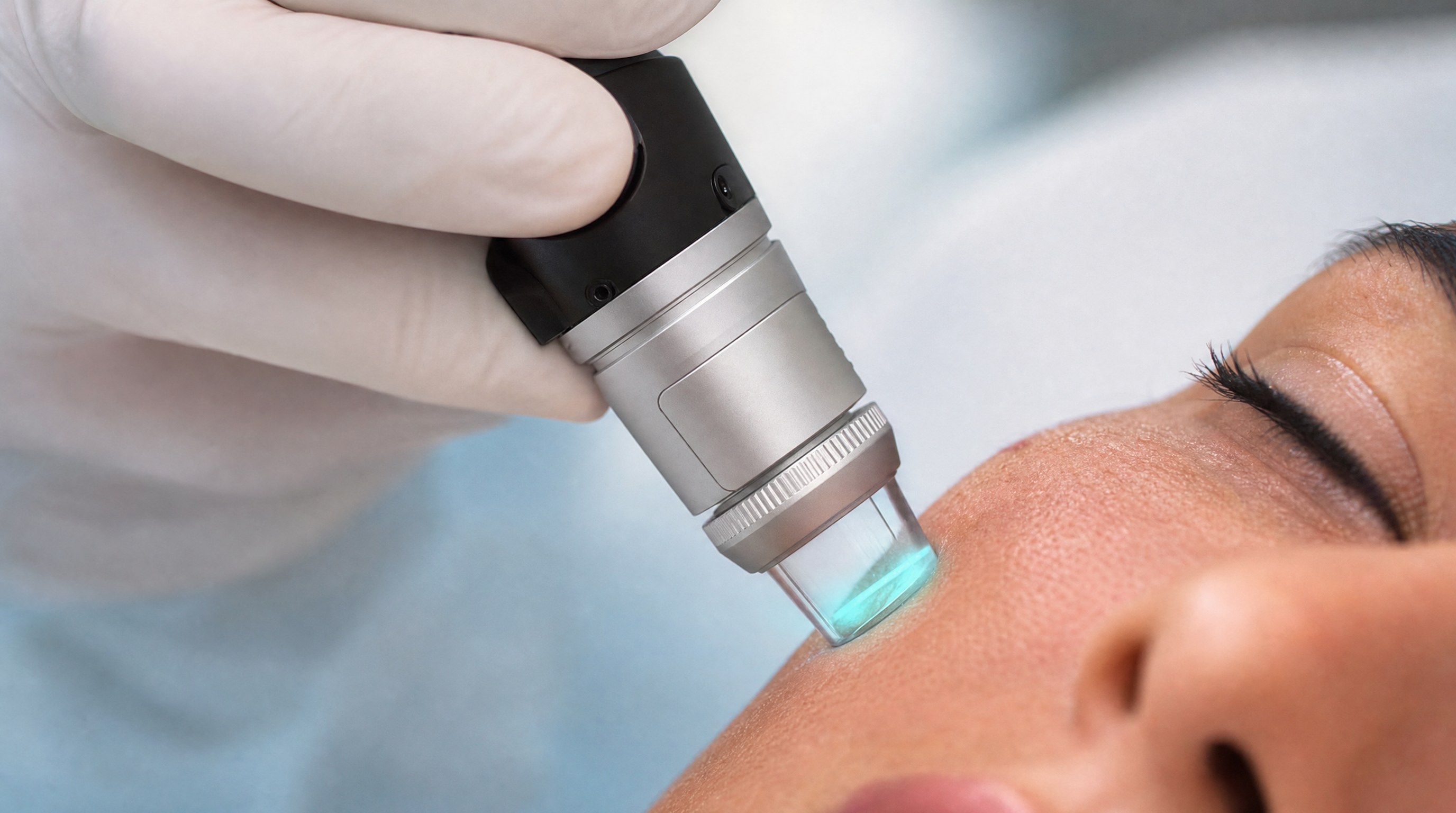
For the patient, protection involves both eyewear and passive barriers. Many clinics apply opaque adhesive patches or metal eye shields directly over the patient's closed eyelids during facial or periocular treatments. These are physical barriers that absorb or reflect stray laser energy. Some practitioners use protective eyewear with side shields to block peripheral scatter. The choice depends on treatment location and laser type. Periocular treatments, especially those near the eyelid or for conditions like xanthelasma removal, warrant the highest level of protection because the eye is the target area or immediately adjacent. For related context, see our note on How Many Laser Hair Removal Sessions You Need.
Staff protection is equally critical. Operators, assistants, and anyone in the laser room must wear appropriate eyewear throughout the treatment session. Stray reflections off dental work, jewelry, or polished skin surfaces can redirect laser light unpredictably. Some facilities install beam delivery enclosures or protective curtains to contain stray light, but eyewear is always the first line of defense. Staff should never remove protective eyewear during a treatment, even briefly, because laser firing may resume without warning.
Training and documentation complete the safety picture. Staff should understand the specific hazards of each laser type in use, the optical density rating required for that wavelength, and the signs of inadequate protection (visible laser light coming through the eyewear, for instance). Facilities should maintain records of eyewear type, serial numbers, and replacement dates. Some organizations perform periodic testing of protective eyewear using spectrometry to confirm optical density has not degraded.
Cost for quality laser safety eyewear typically ranges from 50 to 300 dollars per pair depending on customization and frame quality. Metal eye shields and adhesive patches are inexpensive consumables. Beam enclosures and engineering controls cost significantly more but are justified in high-volume treatment areas. The financial investment in laser eye protection safety is minimal compared to the liability and human cost of vision loss.
No patient should enter a laser treatment room without understanding what protective measures will be used. Asking to see the eyewear, confirming the wavelength labeling, and ensuring all staff are also protected are reasonable patient responsibilities. Providers should welcome these questions as a sign the patient takes safety seriously. In cosmetic laser medicine, eye protection is not a luxury add-on. It is the floor, non-negotiable and always in place.
Related reading: Laser vs Chemical Peel for Sun Damage: Mechanism, Recovery, and Results, CO2 Laser Resurfacing Cost in Beverly Hills: What to Expect.
More in Explainer
View all →- Melasma and Lasers: Why Lower Energy Usually Wins
- Fractional CO2 vs Non-Ablative 1550 and 1927 nm: How to Actually Choose a Resurfacing Laser
- 1550 nm or 1927 nm? What the Two Workhorse Fractional Wavelengths Actually Do to Your Skin
- Ablative vs. Non-Ablative Fractional Resurfacing: What the Wavelength Actually Decides