Skin Concerns · June 4, 2026 · 5 min · By Hugo Lindenbaum
Pulsed Dye Laser vs IPL for Rosacea Redness: What the Clinical Evidence Shows
Understanding how PDL and IPL target facial redness, who benefits most, recovery timelines, and realistic cost expectations.
When evaluating pulsed dye laser vs IPL for rosacea, patients and providers face two distinct technologies with overlapping but different mechanisms of action. Both devices aim to reduce the persistent facial flushing, visible blood vessels, and inflammatory papules characteristic of rosacea, yet they work through fundamentally different principles and carry distinct recovery profiles and efficacy rates.
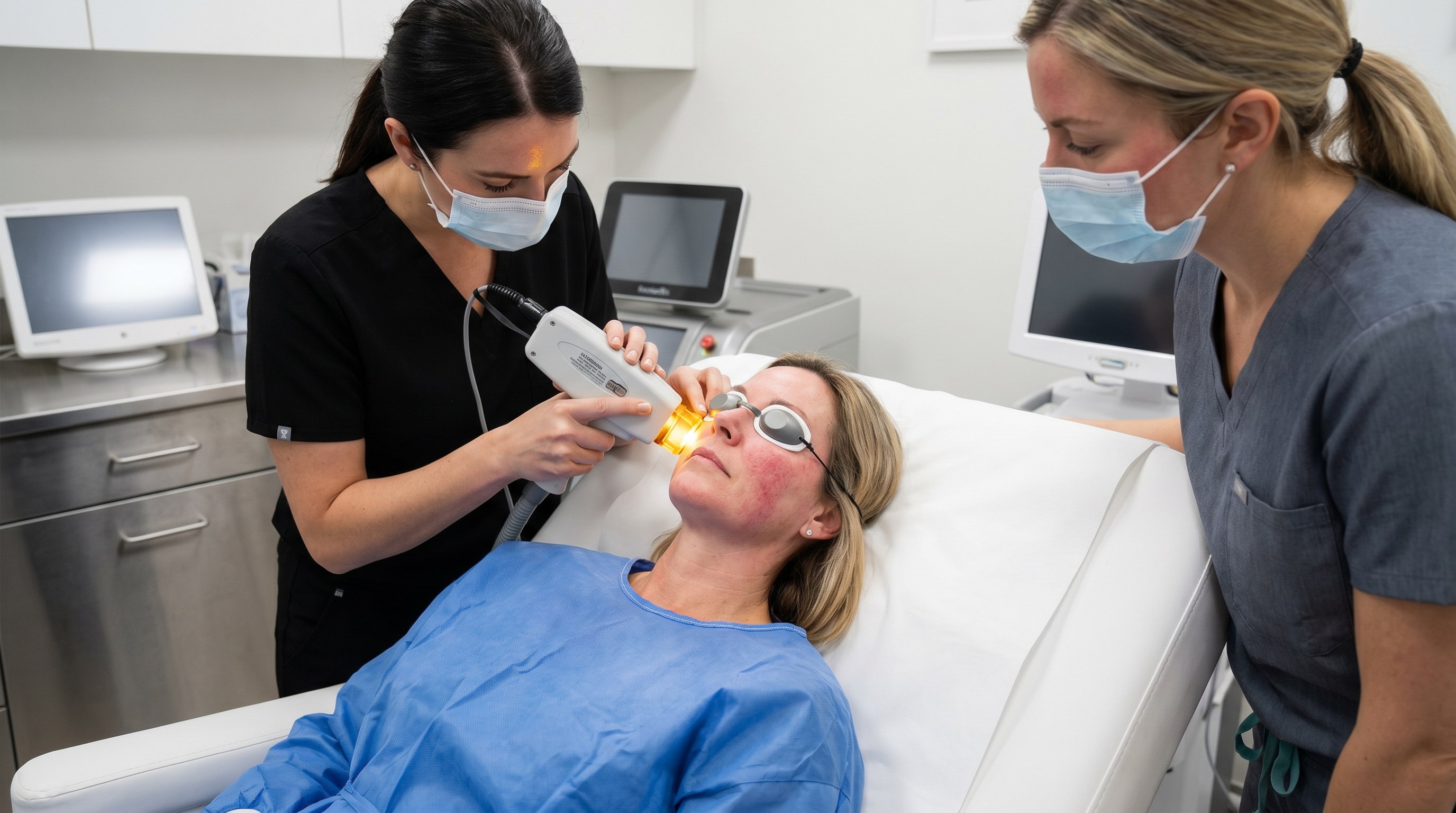
The pulsed dye laser (PDL) operates at a wavelength of 585 to 595 nanometers, which is selectively absorbed by oxyhemoglobin in red blood cells. This wavelength preference means PDL energy is preferentially taken up by the hemoglobin within dilated capillaries and telangiectasia, the hallmark vascular features of rosacea. The laser delivers energy in short pulses, typically measured in milliseconds, causing controlled thermal injury to blood vessel walls. This triggers vessel collapse and reabsorption while leaving surrounding tissue relatively spared. PDL has the longest track record in rosacea treatment, with clinical studies demonstrating 70 to 80 percent improvement in erythema and vascular lesions after a series of treatments. For an independent overview, see Rosacea: causes, triggers, and treatment.
Intense pulsed light (IPL) uses a broader spectrum, typically 515 to 1200 nanometers, delivered through a flashlamp rather than a laser. Because of this wider wavelength range, IPL is absorbed not only by hemoglobin but also by melanin and water. This multi-chromophore approach makes IPL effective for vascular lesions but also capable of treating concurrent rosacea-related pigmentation and mild inflammatory components. The trade-off is that IPL's less-targeted energy delivery means less predictable selectivity for blood vessels alone, which becomes important when considering skin-tone safety.
For candidacy and skin type, PDL is generally considered safer across all skin tones because its narrower wavelength and selective hemoglobin absorption reduce melanin-related side effects. Patients with darker skin types (Fitzpatrick IV to VI) who pursue PDL face lower risk of post-inflammatory hyperpigmentation. IPL, because it absorbs melanin more strongly, carries increased risk of hyperpigmentation in darker-skinned individuals and is often not recommended as a first-line option for patients with significant baseline pigmentation. Some practices use longer-wavelength devices like Nd:YAG lasers for darker skin, though these have different efficacy profiles for superficial rosacea erythema.
In terms of mechanism, PDL's selective photothermolysis results in immediate vessel coagulation and often visible purpura (bruising) that persists for 7 to 14 days post-treatment. IPL typically causes less dramatic purpura but may produce temporary erythema and edema lasting 2 to 4 days. Patients undergoing PDL should expect a more noticeable recovery period, while IPL allows faster return to routine, though results may require more sessions to match PDL efficacy. For related context, see our note on Clear and Brilliant vs Fraxel: Which Gentle Laser Fits You.
Clinical outcomes differ subtly between the two. PDL excels at eliminating telangiectasia (visible dilated vessels) and achieving dramatic reduction in flushing episodes. IPL works well for generalized erythema and can address concurrent rosacea-related pigmentation changes. Most rosacea patients require 3 to 6 treatment sessions spaced 4 to 6 weeks apart. PDL often achieves results in fewer sessions, though individual variation is substantial. Maintenance treatments are typically needed every 9 to 12 months to sustain improvement.
Cost structures reflect the technology differences. PDL treatment sessions typically range from 400 to 800 dollars per session depending on treatment area size and regional pricing. IPL sessions often fall into the 300 to 600 dollars range, though this can vary. A complete treatment course of 4 to 6 sessions means total investment of 1200 to 4800 dollars for PDL or 1200 to 3600 dollars for IPL. Some facilities offer package pricing that reduces per-session cost.
Both technologies are considered non-ablative, meaning they do not remove the outer skin layer. Recovery therefore involves minimal downtime for daily activities, though sun exposure must be carefully managed for several weeks post-treatment. Patients should apply broad-spectrum sunscreen and avoid heat exposure, strenuous exercise, and vasodilating foods immediately after treatment, as these can trigger post-treatment erythema.
The choice between pulsed dye laser vs IPL for rosacea ultimately depends on skin type, the specific rosacea presentation, budget, and downtime tolerance. PDL remains the gold-standard technology for vascular-dominant rosacea and offers superior skin-tone versatility. IPL provides a reasonable alternative for lighter skin types, particularly when erythema and concurrent pigmentation changes predominate. Consultation with a dermatologist or experienced laser provider remains essential for proper candidacy assessment and realistic expectation-setting.
Related reading: Ablative vs. non-ablative laser resurfacing, Fraxel vs Moxi: Comparing Recovery Time.
Keep reading
1550 nm vs 1927 nm: Choosing the Right Non-Ablative Fractional Wavelength for Your Skin Goal